Key Takeaways for Purebred Owners
- Purebred dogs are more prone to specific hereditary conditions due to a smaller gene pool.
- DNA testing can identify carriers of recessive diseases before symptoms appear.
- Clinical screenings (like X-rays and eye exams) are essential for issues that aren't purely genetic.
- Buying from breeders who provide OFA and PennHIP certifications reduces long-term health risks.
- Early detection through regular veterinary checkups allows for manageable lifestyle adjustments.
Choosing a purebred dog often comes with the promise of a predictable temperament and look. But there is a hidden trade-off: the genetic bottleneck. When breeders focus heavily on specific traits, they accidentally concentrate harmful mutations. This means your Golden Retriever might be predisposed to cancer, or your Cavalier King Charles Spaniel could struggle with a collapsing trachea. The good news is that we aren't flying blind anymore. We can now pinpoint these risks before they become crises.
The Genetic Reality of Purebreds
Purebred dogs belong to a closed gene pool. In biology, this leads to homozygosity, where a dog inherits the same version of a gene from both parents. When those genes are defective, the disease manifests. For example, Hereditary Diseases is a category of health conditions passed from parents to offspring through DNA, often appearing as recessive traits in purebred lines. This isn't just a "bad luck" scenario; it's a mathematical outcome of selective breeding.
Take the German Shepherd, for instance. Their structure makes them prone to hip issues, but the genetic drive for that specific slope in their back often reinforces the problem. If you're looking at a puppy, you aren't just looking at a cute face; you're looking at a biological blueprint that might have a few errors in the code. Knowing how to read that blueprint is the difference between a healthy senior dog and a decade of expensive emergency vet visits.
Hip and Joint Disorders: More Than Just Aging
If you've owned a Lab or a Shepherd, you've likely heard of Hip Dysplasia is a genetic condition where the hip joint doesn't develop properly, leading to arthritis and joint failure. This isn't something that just happens because a dog gets old. It's an architectural flaw. The ball-and-socket joint of the hip is loose, causing the bone to rub and grind.
To screen for this, you can't just rely on a puppy's gait. You need a OFA (Orthopedic Foundation for Animals) is a non-profit organization that provides standardized health certifications for hips, elbows, and hearts in dogs. An OFA certification involves X-rays taken at a specific age. Another gold standard is the PennHIP is a method of evaluating hip joint laxity to predict the likelihood of developing osteoarthritis. Unlike a standard X-ray, PennHIP involves manipulating the joint under sedation to see how "loose" it is. If a breeder can't show you these certificates for the parents, you're essentially gambling with your dog's mobility.
| Screening Method | What it Measures | Best Timing | Reliability |
|---|---|---|---|
| OFA X-Rays | Joint shape and alignment | After 24 months | High (Standard) |
| PennHIP | Joint laxity (looseness) | As early as 16 weeks | Very High (Predictive) |
| Physical Palpation | Symmetry and range of motion | Anytime | Low (Symptomatic) |
Vision and Neurological Risks
Some of the most heartbreaking genetic issues are the ones that steal a dog's senses. Progressive Retinal Atrophy (PRA) is a degenerative eye disease that causes the retina to waste away, eventually leading to total blindness. This is common in Poodles and Cocker Spaniels. Because the blindness happens slowly, owners often don't notice until the dog starts bumping into furniture.
Screening for PRA has evolved. We now have DNA tests that check for specific mutations. A simple cheek swab can tell you if a dog is "Clear," a "Carrier," or "Affected." Carriers don't go blind, but they can pass the gene to their pups. If you're breeding, you never pair two carriers together. For the owner, knowing a dog is affected allows you to arrange furniture and keep the home consistent, which helps the dog navigate visually impairedly.
Then there is Degenerative Myelopathy (DM) is a painless but progressive disease of the spinal cord that leads to paralysis of the hind limbs. It's a cruel disease often seen in Boxers and Dobermans. There is no cure, but a DNA test can confirm the presence of the SOD1 mutation. Knowing this early helps you plan for assistive devices, like canine wheelchairs, before the dog loses the ability to walk.
Cardiac Complications and Hidden Heart Defects
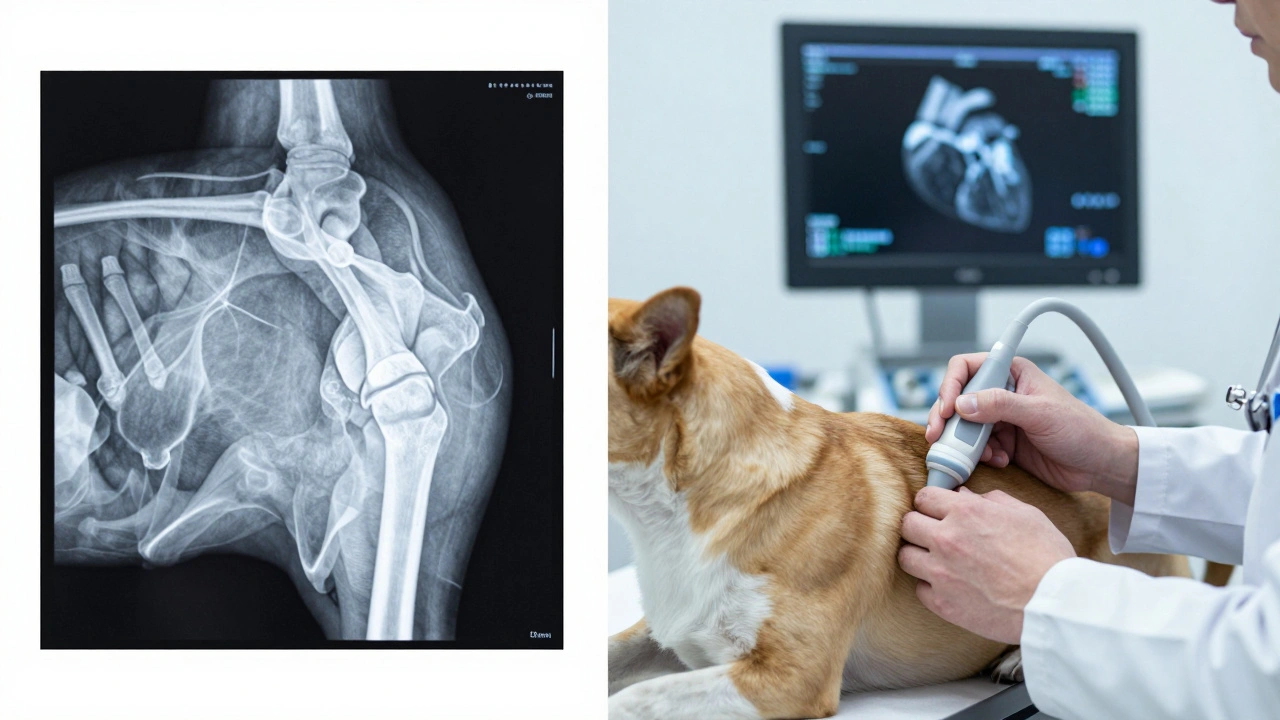
Heart issues are the silent killers in many purebred lines. The most notorious is Subvalvular Aortic Stenosis (SAS) is a narrowing of the aortic valve that restricts blood flow from the heart to the rest of the body. This is common in Golden Retrievers and Bulldogs. A dog might seem perfectly healthy until they suddenly collapse during exercise-a sign of heart failure.
You cannot find SAS with a DNA test. It requires a Echocardiogram is an ultrasound of the heart that allows vets to see the valves and chambers in motion. A board-certified veterinary cardiologist should perform this exam. When shopping for a puppy, ask if the parents had a "clear heart" certification. A vet just listening with a stethoscope might miss a subtle murmur that an echo would catch instantly.
The Role of DNA Testing in Modern Ownership
We've entered the era of the "genomic profile." Companies now offer panels that screen for dozens of diseases at once. genetic dog health screening is no longer just for professional breeders; it's for anyone who wants to be proactive. These tests look for Single Nucleotide Polymorphisms (SNPs)-essentially typos in the DNA sequence.
However, a DNA test is not a crystal ball. It tells you about predisposition, not destiny. For instance, a dog might have a genetic marker for obesity or certain allergies, but a strict diet and clean environment can mitigate those risks. The real value of DNA testing is in the things we can't change. If a dog is genetically predisposed to a certain type of epilepsy, you can start monitoring them more closely and have an emergency medication kit ready before the first seizure occurs.

Building a Screening Checklist
If you are bringing a new purebred into your home, don't let the excitement cloud your judgment. You need to see evidence. A reputable breeder will be proud to show you their health records. If they say, "The parents are healthy, trust me," that is a massive red flag. Trust is not a medical screening.
- Request OFA or PennHIP certificates: Look for "Fair," "Good," or "Excellent" ratings.
- Ask for CAER (Companion Animal Eye Examiners Republic) results: Ensure the eyes were checked within the last year.
- Check for DNA panels: Specifically for breed-specific issues like DM or PRA.
- Verify Heart Clearance: Ensure a cardiologist performed an echo on the parents.
- Review the Pedigree: Look for patterns of early deaths or chronic illnesses in the lineage.
Managing a Predisposed Dog
So, you found out your dog has a genetic predisposition. Now what? The goal shifts from prevention to management. For joint issues, starting a glucosamine and chondroitin supplement early can slow the degradation of cartilage. Weight management is the single most effective way to extend the life of a dog with hip dysplasia. An overweight Lab with bad hips is a recipe for misery; a lean Lab can often maintain mobility well into their senior years.
For those with cardiac risks, avoid extreme over-exertion in high heat, as this puts extra strain on the heart muscle. Regular check-ups every six months instead of annually allow your vet to catch the first signs of a heart murmur or respiratory distress. Genetic issues are a challenge, but they aren't a sentence. With the right screening and a tailored care plan, purebred dogs can live long, happy lives.
Is DNA testing enough to guarantee a healthy puppy?
No. DNA testing only finds mutations that we already know how to look for. It cannot detect structural issues like hip dysplasia, heart valve narrowing, or environmental health problems. You need a combination of DNA tests and physical clinical screenings (X-rays, ultrasounds) for a full picture.
What is the difference between a carrier and an affected dog?
A carrier has one copy of a recessive disease gene but does not show any symptoms of the disease. An affected dog has two copies (one from each parent) and will actually develop the health issue. Carriers are healthy, but they can pass the gene to their offspring.
How often should I screen my purebred dog for genetic issues?
DNA tests only need to be done once in a dog's life because their genetic code doesn't change. However, clinical screenings like eye exams or heart checks should be done annually or as recommended by your vet, as these conditions can progress or develop over time.
Are mixed-breed dogs completely free of these genetic issues?
Not necessarily, but they generally have "hybrid vigor." Because they have a more diverse gene pool, they are less likely to inherit two copies of the same recessive mutation. However, they can still carry these genes or develop common canine health issues.
Which is better, OFA or PennHIP for hip screening?
PennHIP is generally considered more accurate and predictive because it measures joint laxity, whereas OFA looks at the shape of the joint. PennHIP can also be performed on much younger puppies, giving breeders and owners an earlier warning sign.