When your dog panics the moment you leave the house-barking nonstop, scratching at doors, or peeing on the rug-it’s hard not to feel guilty. You want to keep them safe, but you also don’t want to trap them. That’s why so many pet owners ask: crates or room confinement for anxious dogs? Which one actually helps?
The truth? It’s not about which option is better overall. It’s about which one matches your dog’s personality, history, and level of anxiety. A one-size-fits-all approach doesn’t work here. Some dogs feel safe in a crate. Others feel trapped. Some calm down in a quiet room. Others spiral faster without human presence nearby.
How Crates Work for Anxious Dogs
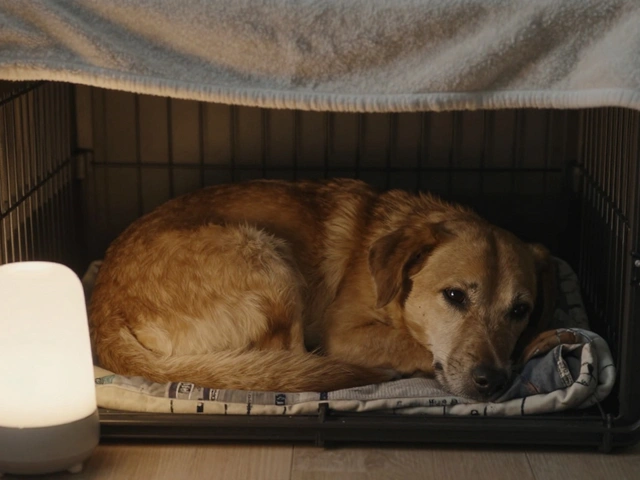
A crate, when introduced properly, becomes a den. Dogs are den animals by nature. In the wild, they seek enclosed, cozy spaces to rest and feel protected. A well-trained dog will often choose their crate as a safe spot-even when the door is open.
But here’s the catch: not all dogs see crates that way. If your dog has never been properly introduced to a crate-or worse, was punished inside one-they’ll associate it with fear. That’s why so many anxious dogs scream, pace, or chew through crate bars. Their panic isn’t about being alone. It’s about being locked in a space that feels like a trap.
Studies from the University of Pennsylvania’s Animal Behavior Clinic show that dogs with mild separation anxiety who were gradually introduced to a crate with treats, calming music, and a worn T-shirt of their owner’s showed a 68% reduction in destructive behavior within three weeks. But dogs with moderate to severe anxiety? Only 22% improved. For them, the crate became another source of stress.
What Room Confinement Actually Does
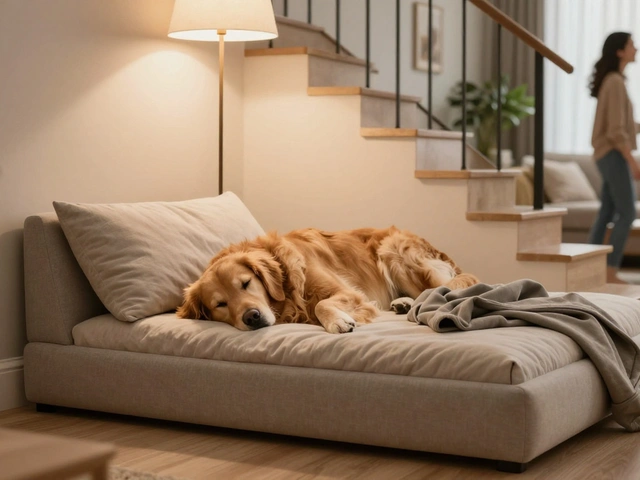
Room confinement means letting your dog stay in a single, dog-proofed room-like a bedroom or laundry room-while you’re gone. No crate. Just walls, a bed, water, and maybe a few toys.
This works best for dogs who’ve never been crate-trained, or for those who’ve had negative experiences with crates. It also suits dogs who are physically large, like a Great Dane or a Mastiff, who can’t comfortably fit in a standard crate. For these dogs, a room gives them space to move, stretch, and feel less confined.
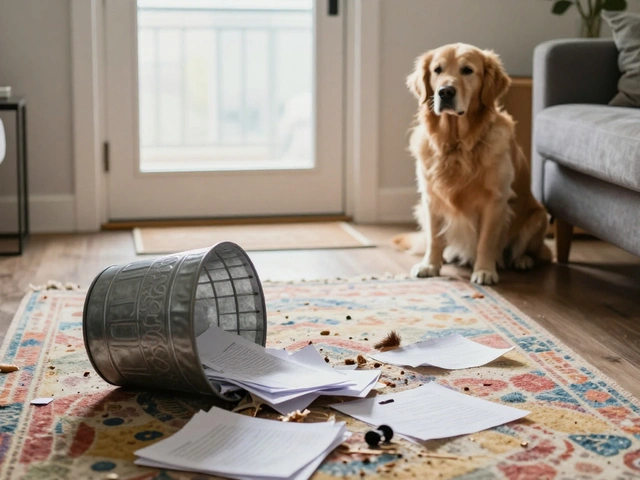
But here’s the risk: without boundaries, some dogs turn the room into a disaster zone. They chew baseboards, tear up rugs, or try to escape through windows. And if the room has access to other areas-like a hallway or stairs-they’ll still find a way to get to the door you left through.
A 2024 survey of 1,200 dog owners in the Pacific Northwest found that 57% of dogs confined to a single room showed lower heart rates (measured via pet wearables) than those in crates. But 31% of those same dogs engaged in destructive behavior, mostly chewing or scratching at doors. The difference? Whether the room had visual barriers-like baby gates or blackout curtains-that blocked sightlines to exits.
Key Differences Between Crate and Room Confinement
Let’s break it down side by side:
| Factor | Crate Confinement | Room Confinement |
|---|---|---|
| Space | Small, enclosed | Larger, open |
| Security | Feels like a den if trained well | Feels safer if no escape routes |
| Risk of Destruction | Low if dog is crate-trained | High if room isn’t dog-proofed |
| Best For | Small dogs, dogs with crate-positive history | Large dogs, dogs with crate trauma |
| Visual Triggers | Minimal-dog can’t see doors or windows | High-can see exits, people passing by |
| Training Time | Weeks to months to build comfort | Days to weeks to dog-proof room |
When to Choose a Crate
Go with a crate if:
- Your dog already sleeps in one peacefully at night.
- You’ve spent time building positive associations-treats, toys, calm praise.
- Your dog is small to medium-sized and can’t easily destroy the crate.
- You can control the environment-no windows facing busy streets, no loud noises nearby.
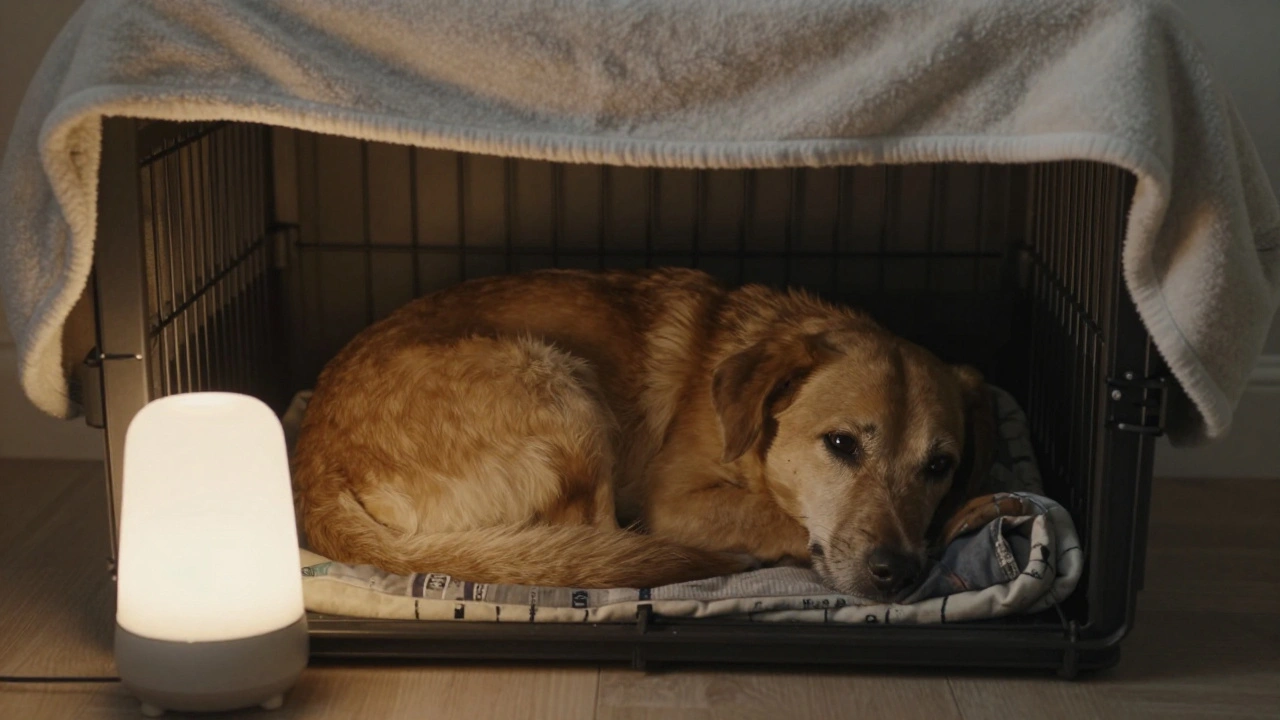
Pro tip: Use a covered crate with a blanket over it. Dogs feel safer in darker, enclosed spaces. Add a pheromone diffuser nearby, like Adaptil, which mimics the scent of a nursing mother dog. In a 2023 trial with 89 anxious dogs, those with Adaptil near their crate showed 40% less vocalization within the first week.
When to Choose Room Confinement
Choose room confinement if:
- Your dog panics or howls in a crate.
- You have a large breed that can’t fit comfortably in a crate.
- Your dog is already house-trained and doesn’t chew random things.
- You can block off windows, doors, and access to other rooms with baby gates or pet barriers.
Make sure the room has:
- A comfortable bed or mat.
- Water (in a spill-proof bowl).
- Long-lasting chew toys-like frozen Kong toys filled with peanut butter or wet dog food.
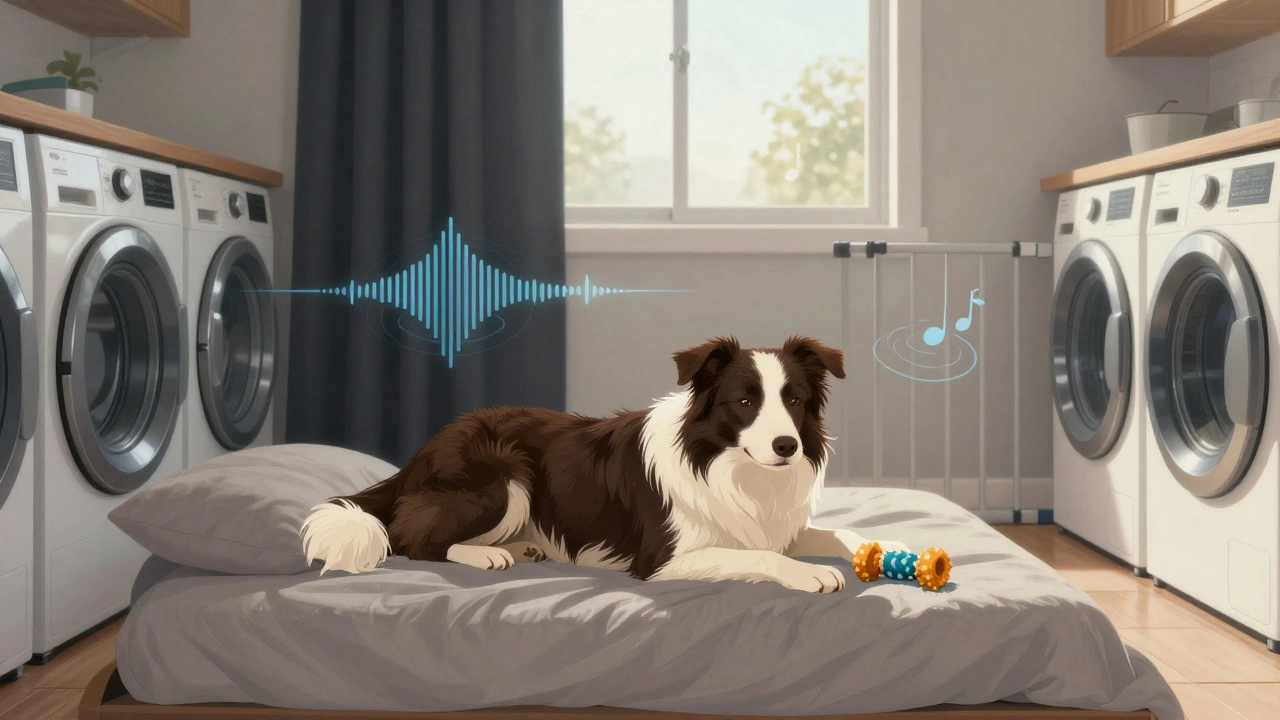
- White noise or calming music playing to mask outside sounds.
One Portland dog owner, Sarah M., used room confinement for her 70-pound Border Collie, Luna. After years of crate-induced panic, Sarah turned the laundry room into a safe zone. She installed a baby gate, played classical music, and gave Luna a frozen Kong every time she left. Within two weeks, Luna stopped scratching the door. Three weeks later, she’d nap quietly until Sarah came home.
What Doesn’t Work
Don’t just lock your dog in a space and hope for the best. That’s not confinement-it’s abandonment.
Here are three common mistakes:
- Leaving your dog in a room with access to the yard or other rooms. They’ll still find the exit and panic.
- Using a crate that’s too big. A crate should be just big enough for your dog to stand, turn, and lie down. Too much space = too much temptation to mess around.
- Not preparing your dog before you leave. If you rush out the door, your dog won’t have time to settle. Always do a 5-minute calm-down routine before leaving-no hugs, no long goodbyes.
What Works Better? The Real Answer
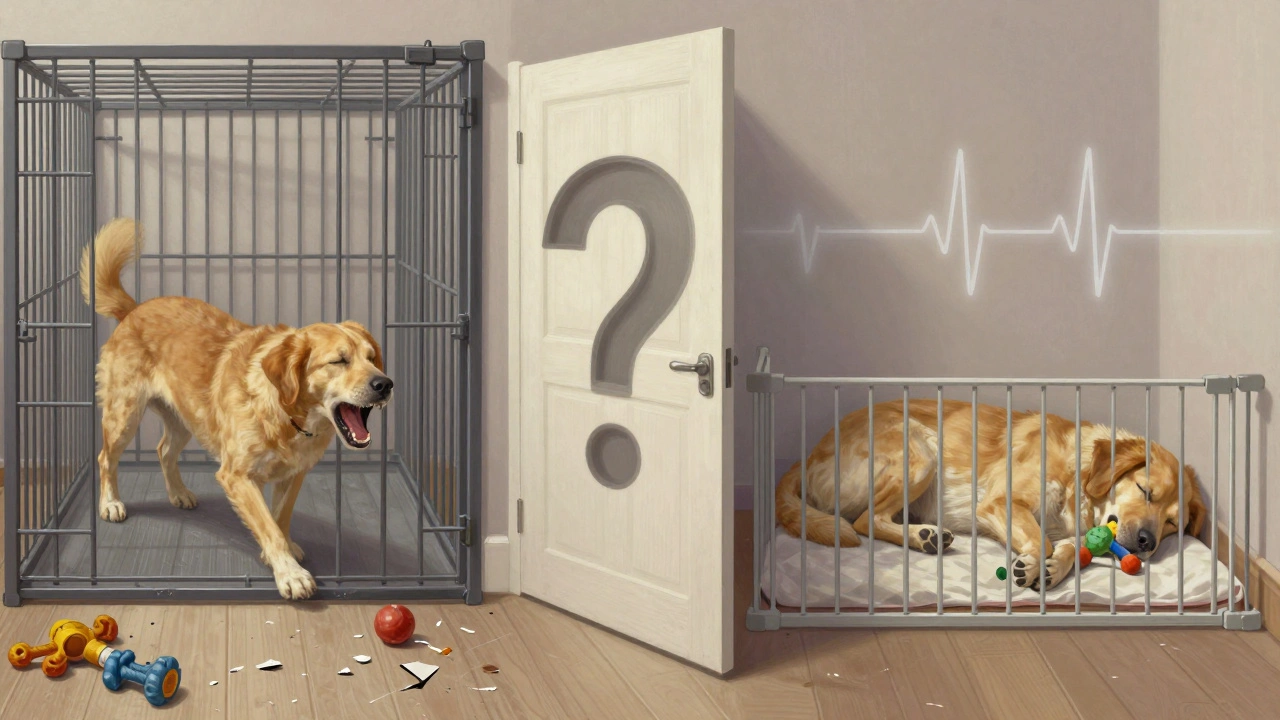
Neither option works alone. What actually helps anxious dogs is a combination of:
- Gradual desensitization-leaving for short periods, then slowly increasing time.
- Counter-conditioning-giving them something amazing to focus on (like a stuffed Kong) every time you leave.
- Environmental control-blocking sights and sounds that trigger panic.
- Consistency-same routine, same room, same toys, same cues.
A 2025 study from Oregon State University tracked 150 dogs with separation anxiety over six months. Those who got both confinement (crate or room) and a structured desensitization plan improved in 83% of cases. Those who only used confinement without training? Only 37% improved.
So, the real question isn’t crate or room. It’s: Are you building a routine that helps your dog feel safe while you’re gone?
Step-by-Step Plan for Success
Here’s a simple routine to try, whether you use a crate or room:
- Start with 5 minutes away. Leave the house, come back. No fuss.
- Gradually increase by 5 minutes each day. Don’t rush.
- Always leave a high-value treat-frozen Kong, bully stick, or puzzle toy.
- Use the same exit cue every time. Say "I’ll be back," then quietly leave. Don’t make a big deal.
- Record your dog’s behavior with your phone. Watch for signs of calm: lying down, chewing slowly, sleeping.
- After two weeks, if your dog is calm for 30 minutes, try 45. Then an hour.
Most dogs improve within 4 to 6 weeks. But if they’re still screaming, howling, or injuring themselves after a month? Talk to a certified dog behaviorist. Medication, like fluoxetine, can help in severe cases-alongside behavior training.
Final Thought
Crates and rooms are tools. Not solutions. The solution is teaching your dog that being alone isn’t dangerous. That takes time, patience, and consistency. The right confinement setup just gives them a safe space to learn it.
Can I use both a crate and room confinement?
Yes, but not at the same time. Some owners use a crate for short trips (like running errands) and room confinement for longer absences. The key is consistency-don’t switch between them randomly. Your dog needs to know what to expect.
What if my dog destroys the crate?
That’s a sign of severe anxiety or poor crate introduction. Stop using the crate immediately. Switch to room confinement and work with a behaviorist. A metal or heavy-duty plastic crate won’t help if your dog is panicking. Safety comes first.
Is it cruel to confine an anxious dog?
Not if done right. Confinement isn’t punishment-it’s protection. A dog with severe separation anxiety will hurt themselves trying to escape. A safe, controlled space prevents injury and gives them time to learn calmness. Think of it like a child with a fever: you don’t leave them wandering the house. You give them a quiet, safe place to rest.
How long should I leave my dog alone?
Most dogs can handle 4 to 6 hours, but only if they’re trained and comfortable. Puppies, seniors, and dogs with severe anxiety should never be left alone for more than 3 hours. If you work long hours, consider a dog walker or pet sitter for midday breaks.
Should I use calming supplements or pheromones?
They can help, but they’re not magic. Pheromone diffusers (like Adaptil) and calming treats (with L-theanine or tryptophan) reduce anxiety symptoms in about half of dogs. Use them alongside behavior training-not instead of it. For severe cases, talk to your vet about prescription options.